Best Time for Land Clearing Jacksonville FL — What a $9,400 Rainy Season Mistake Taught Us
Introduction:
The best time for land clearing Jacksonville FL is not when you are ready.
It is when the ground is ready.
A Northside developer learned this in July 2022.
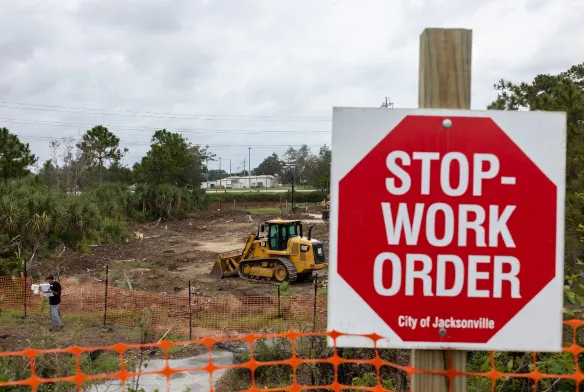
He booked a crew for 14 acres during peak rainy season.
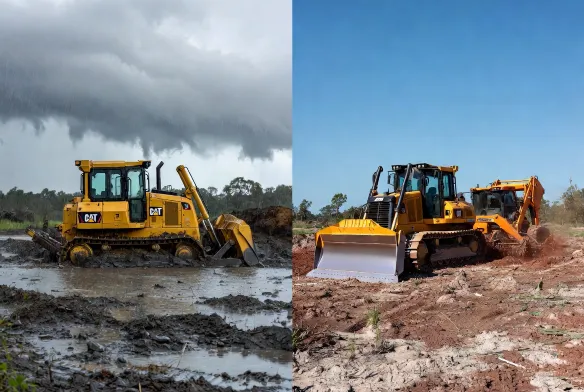
By day three, a CAT D6N had sunk 18 inches into saturated Duval County clay.
Equipment recovery cost $2,800. The project stopped for 11 days.
Rescheduling crew and equipment added $6,600 to a fixed-bid contract.
Total preventable loss: $9,400.
The same job in November would have run clean in four days flat.
The 2017 Summer Job That Changed Our Booking Policy
We used to accept Jacksonville land clearing jobs year-round without seasonal screening.
Summer work paid well. Clients were eager. We said yes.
August 2017 — a 6-acre Westside residential development.
First day was fine. Second day, afternoon thunderstorms dumped 3 inches in 90 minutes.
Northeast Florida’s rainy season averages 55 inches annually — most of it June through September.
Sandy topsoil on that Westside lot turned to slurry.
Our Komatsu PC360 tracked mud across the neighbor’s easement.
That cleanup cost the client $1,900 and us a two-star review we still carry.
Now every booking from June through September gets a soil moisture assessment first.
We use a Trimble GPS unit to check site elevation and a manual probe to read drainage depth.
If the lot sits below 15 feet elevation and has clay subsoil — we push the booking to October.
Every time.
Land Clearing Season Jacksonville FL — Month by Month Breakdown
When to Clear Land Jacksonville Florida — The Honest Ranking
October through April is Jacksonville’s best clearing window.
Here is exactly why — month by month:
October — November:
Ground firms up after rainy season. Vegetation growth slows.
Palmetto scrub and cogon grass are easier to track and cut.
SJRWMD permit reviews average 30 days — book in September for October start.
Duval County’s drier northeast winds drop humidity below 65 percent.
Our Fecon FTX148 mulcher runs 20 to 30 percent faster in these conditions than in July.
Best window for residential lots and acreage clearing under 10 acres.
December — February:
Jacksonville winters run mild — average 52 to 68 degrees Fahrenheit.
Ground stays firm. Daylight is shorter but humidity is lowest of the year.
Vegetation density drops as deciduous growth thins.
Best window for large commercial clearing — 10 acres and above.
Permit processing through Duval County is also faster in winter — fewer competing applications.
March — April:
Good clearing window before the wet season returns.
Soil moisture is rising but still manageable on elevated lots.
Tree canopy starts recovering — live oak and Florida pine growth accelerates by April.
Jacksonville’s Tree Protection Ordinance Chapter 656 enforcement is active year-round.
Get permits pulled before March if your project involves protected trees.
May — September (Avoid if Possible):
Florida’s rainy season. June through September averages 7 to 9 inches monthly in Duval County.
Equipment bogs down in saturated clay subsoil on low-lying lots.
Debris hauling cost rises 15 to 25 percent on wet sites — heavier loads, slower trucks.
Cogon grass and Brazilian pepper growth is at peak — cleared areas can show regrowth within 21 days.
We still take summer jobs — but only on elevated, well-drained sites with confirmed soil data.
How Jacksonville’s Soil Type Changes Your Timing
Most property owners do not know their soil classification before booking a clearing crew.
We check it before every job using a USDA Web Soil Survey analysis.
Three soil types dominate Duval County:
Lakeland fine sand — drains fast, clears well even in moderate rain.
Found mostly in Southside and Mandarin elevated lots.
Plummer fine sand — high water table, poor drainage.
Found in low-lying Westside and Northwest Jacksonville corridors.
These lots flood within 6 to 12 hours of heavy rain.
Otela fine sand over clay — mixed drainage, unpredictable.
Common in Arlington and Regency-area residential developments.
This soil type stalls equipment on the second day if rain hits overnight.
A single soil assessment takes 20 minutes on-site.
It saves clients an average of $3,000 to $9,000 in weather-related delays and equipment recovery.
We do not charge for this assessment on any Duval County project.
Permits and Timing — The Jacksonville Calendar Nobody Gives You
SJRWMD Environmental Resource Permit: 30 to 45 business days.
Submit in August or September for an October clearing start.
Submit in February for a March or April start.
Duval County Land Alteration Permit: 10 to 15 business days.
Required for clearing over 1 acre or within 100 feet of a drainage corridor.
Jacksonville Tree Protection Ordinance Chapter 656:
No seasonal exemptions. Active year-round.
Any protected live oak over 8 inches diameter requires a permit before clearing.
Fine: $500 per inch of diameter removed without permit.
A 24-inch live oak removed without authorization = $12,000 fine.
Our scheduling rule:
Pull permits in month one.
Clear in month two.
Never reverse that order.
CONCLUSION:
The best time for land clearing Jacksonville FL is October through April — full stop.
Summer work is possible on the right lot with the right data.
The $9,400 Northside mistake happened because nobody checked the calendar or the soil.
Both are free to check before the first machine rolls.
Call Marcus directly at (904) 748-4055.
We will tell you whether your Duval County property is ready to clear right now —
or whether waiting 60 days will save you more than the delay costs.
FAQS
Start With a Free Site Walk — Not a Fine
The best time for land clearing Jacksonville
FL is October through April — full stop.
Summer work is possible on the right lot
with the right data.
The $9,400 Northside mistake happened because
nobody checked the calendar or the soil. Both
are free to check before the first machine rolls.
Call Marcus directly at (904) 748-4055. We will
tell you whether your Duval County property is
ready to clear right now — or whether waiting
60 days will save you more than the delay costs.
Call Marcus directly at (904) 748-4055. Free site walk.