Brazilian Pepper Tree Removal Jacksonville FL — 5 Brutal Truths Nobody Tells You Before You Clear
INTRODUCTION :
Brazilian Pepper Tree Removal Jacksonville FL — 5 Brutal Truths Nobody Tells You Before You Clear
Brazilian pepper tree removal Jacksonville FL is one of those jobs where doing
it wrong is actively worse than not starting at all.
A Mandarin homeowner called us in May 2023.
One acre of dense Brazilian pepper — 12 to 18 feet tall, red berries, full canopy.
A previous crew had come through six months earlier with a brush hog.
Cut everything to six inches. Cleared in one day. Took a check and left.
By April, the regrowth was denser than the original stand.
Cutting Brazilian pepper without treating the root system does not remove the plant.
It signals the root network to multiply.
We spent three days undoing four days of work that made the problem worse.
The 2022 Westside Job Where One Wrong Cut Cost $9,800
A Westside commercial developer contacted us in January 2022.
4.2 acres of mixed Brazilian pepper and cogon grass on a parcel earmarked for
light industrial development.
The site had been brush-hogged twice in the previous 14 months by two different crews.
Neither crew had treated the root systems.
Neither had applied herbicide post-cut.
By the time we arrived, the cogon grass had spread from a 0.4-acre patch to 1.8 acres.
Brazilian pepper root mass had extended laterally an additional 6 to 9 feet per plant
from the stimulation of repeated cutting.
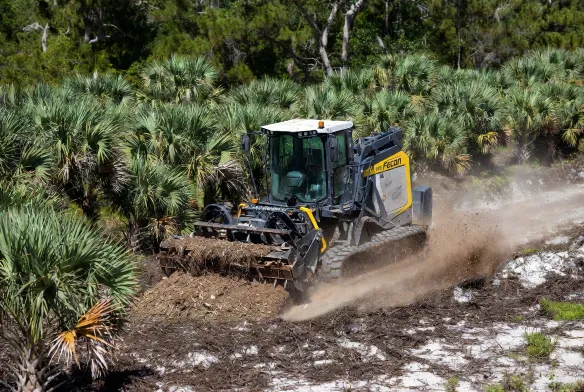
Remediation required three passes — mechanical removal with a Fecon FTX148,
targeted herbicide application, and a 90-day monitoring period with two follow-up
spot treatments.
Total cost: $9,800.
The original two brush-hogging jobs had cost the developer $2,100 combined.
He paid $11,900 to undo $2,100 worth of incorrect work.
Invasive Species Land Clearing Jacksonville FL — Why These Plants Are Different
Most Duval County vegetation clears predictably.
Palmetto scrub, native pine, live oak — remove it, it does not return as a problem.
Three invasive species on Jacksonville FL land clearing sites behave completely differently:
Brazilian peppertree (Schinus terebinthifolius):
Introduced to Florida in the 1840s as an ornamental plant.
Now classified as a Florida noxious weed by the Florida Department of Agriculture.
Grows 15 to 30 feet as tree or dense thicket shrub.
Root system extends 12 to 18 feet laterally from the trunk base.
Produces allelopathic chemicals — compounds released into soil that actively suppress
germination and growth of surrounding native plants.
Cutting without stump treatment causes resprouting from 8 to 14 dormant root buds
per plant within 21 to 45 days in Jacksonville FL summer conditions.
Red berries are viable seed — birds disperse seed actively across cleared areas post-cut,
seeding new growth within the same season.
Cogon grass (Imperata cylindrica):
Listed as one of the world’s 100 worst invasive species by the IUCN.
Rhizomatous root system extends 4 feet deep and spreads aggressively underground.
A single cutting pass distributes rhizome fragments — each fragment can establish
a new colony within 14 days in Northeast Florida’s warm, humid soil conditions.
Cogon grass increases wildfire fuel load dramatically.
It dries faster than native ground cover and burns at temperatures 2 to 3 times
higher than surrounding vegetation.
Three Duval County residential lots in our project log have had wildfire damage
traced directly to untreated cogon grass stands on adjacent parcels.
Melaleuca (Melaleuca quinquenervia):
Originally introduced for Everglades drainage — now spread across 400,000 acres of Florida.
Releases allelopathic compounds similar to Brazilian pepper.
Thrives in wet conditions — found in low-lying Northwest Jacksonville and Westside lots
near drainage corridors.
Cutting melaleuca without herbicide treatment stimulates crown sprouting —
a single cut tree can produce 20 to 40 new sprout stems from the cut crown within
one growing season.
Cogon Grass Removal Jacksonville Florida — What the Process Actually Looks Like
Three invasive species on Jacksonville FL land clearing sites behave completely differently:
| Invasive Species (Duval County) | Growth & Root Behavior | The Danger (Why It Fails) | Correct Treatment Protocol |
|---|---|---|---|
| Brazilian Peppertree Schinus terebinthifolius | Grows 15-30 ft. Roots extend 12-18 ft laterally. Releases allelopathic chemicals into soil. | Root Multiplication Cutting triggers 8-14 dormant buds to resprout in 21-45 days. | Immediate Cut-Stump Treatment Triclopyr (50% Garlon 4 Ultra) within 30-60 mins. |
| Cogon Grass Imperata cylindrica | Rhizomatous root system extends 4 ft deep. Spreads aggressively underground. | Wildfire & Fragment Risk Fragments establish new colonies in 14 days. Burns 2-3x hotter. | Systemic Foliar Spray Imazapyr (Arsenal AC) applied 45 days post-cut during active growth. |
| Melaleuca Melaleuca quinquenervia | Thrives in wet conditions (Northwest/Westside lots near drainage corridors). | Crown Sprouting Explosion Untreated cut stimulates 20-40 new sprout stems from a single crown. | Mechanical + Herbicide combo Targeted chemical treatment to eliminate the root crown structure. |
Why Mechanical Removal Alone Never Works on Cogon Grass or Brazilian Pepper
Mechanical removal — dozer push, forestry mulcher, brush hog — is step one. Not the solution.
On every invasive species clearing job in Jacksonville FL, the process has four required steps:
Step 1 — Mechanical removal.
Fecon FTX148 or John Deere 333G skid steer for above-grade biomass.
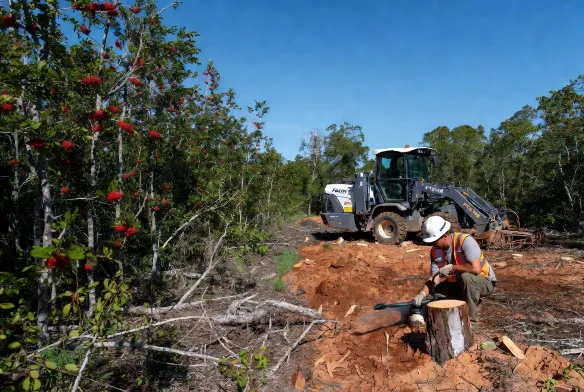
Brazilian pepper stumps cut to 2 to 4 inches above grade for herbicide application access.
Cogon grass mowed or mulched to reduce standing biomass before herbicide penetration.
Step 2 — Targeted herbicide application within 30 to 60 minutes of cutting.
Brazilian pepper: triclopyr-based basal bark treatment or cut-stump treatment
with 50 percent Garlon 4 Ultra in oil carrier applied immediately to cut surface.
Cogon grass: imazapyr (Arsenal AC) applied to actively growing foliage — minimum 45
days after mechanical disturbance to allow rhizome recovery and systemic absorption.
Application timing determines efficacy. Both plants must be in active growth —
not dormant — for systemic herbicide to reach the root network.
Step 3 — 60 to 90 day monitoring period.
Resprout and regrowth mapping using GPS-marked treatment zones.
Spot retreatment on any new growth above 4 inches before the plant re-establishes
lateral root extension.
Step 4 — Soil restoration.
Native ground cover establishment in cleared zones prevents immediate reinvasion.
Bahia grass, wire grass, or native wildflower seed mix applied within 30 days
of final herbicide treatment creates competitive pressure against reinvading seedlings.
Brazilian pepper seed in Jacksonville FL bird populations guarantees reseeding of
any bare cleared ground within one growing season without this step.
What the FLEPPC List Means for Your Jacksonville FL Clearing Project
The Florida Exotic Pest Plant Council publishes a ranked list of invasive species
categorized by ecological impact across Florida.
Brazilian pepper is a Category I invasive — causing significant disruption to native
plant communities. Cogon grass is also Category I. Melaleuca is Category I.
Category I designation does not automatically trigger a removal permit requirement —
but it does affect several adjacent permit processes in Duval County:
SJRWMD Environmental Resource Permit applications for lots adjacent to wetlands
require documentation of invasive species treatment plans if Category I species
are present within the project boundary or buffer zone.
Jacksonville’s Urban Forestry Division may require invasive species removal
as a condition of tree removal permits on lots with mixed native and invasive canopy.
Duval County stormwater management plans increasingly include invasive species
management as a condition for post-development maintenance agreements.
If your Jacksonville FL property has a Category I invasive species presence and
you are pulling any permit — wetland, tree, building, or site prep — disclose it
in the application. Failing to disclose known invasive species on a permitted lot
has resulted in permit revocation and remediation orders in Duval County.
CONCLUSION
Brazilian pepper tree removal Jacksonville FL is not a one-day brush-hogging job.
Cogon grass removal is not a mow-and-done service.
The Mandarin homeowner paid twice because the first crew did not know the difference.
The Westside developer paid $9,800 to undo $2,100 worth of incorrect mechanical work.
Both outcomes were entirely preventable with the right four-step process.
Call Marcus directly at (904) 748-4055.
We will assess your Duval County lot, identify every invasive species present,
map the treatment zones, and give you a realistic timeline and cost —
before a single machine rolls.
Brazilian Pepper Tree Removal Jacksonville FL — Frequently Asked Questions
Stop Paying Twice — Hire the Right Crew First
The Orange Park homeowner cleared his lot in four days — fast price, machines gone by Friday.
Three weeks later, his drainfield failed the perc test. Soil remediation cost: $7,400.
The clearing crew had moved on. He paid alone.
Call Marcus at (904) 748-4055. Free site walk. No deposit required.